
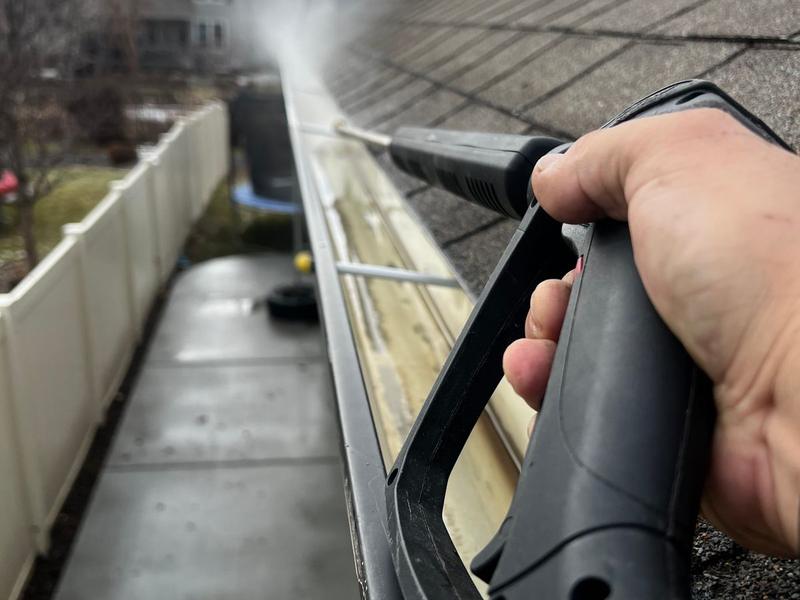
Gutter guards do work in the Pacific Northwest, but only in the sense that they reduce clogs; they don't end gutter maintenance. Under Douglas fir and western red cedar, the needles are small enough to beat or bury most guard styles, and a long wet season keeps that debris soggy and sticky. The right guard can stretch the time between full cleanings and keep big leaf loads out of the trough. The wrong one can trap debris where you can't see it or send water over the edge in a storm.
Why Seattle is hard on gutter guards
Most gutter guards were designed with broad leaves in mind. Around Seattle, the debris mix is different and changes through the year:
- Douglas fir needles are short, stiff and fall all year, with heavier drops after windstorms. They slide through openings and lodge in holes.
- Western red cedar sheds flat sprays of foliage and fine brown scale that breaks down into a mulch-like paste.
- Bigleaf maple and alder leaves arrive in a wave in fall. They are large enough for almost any guard to block, but they mat flat over the top and stay wet for weeks.
- Cones, catkins and seed husks come down in spring and roll into valleys and corners.
- Roof moss and shingle grit wash down with every rain. Granules from aging asphalt shingles act like sand, and moss clumps break loose as they dry and rehydrate.
Add drizzle that keeps everything damp from fall through spring, and you get debris that clings to guards instead of blowing off.
How each type of guard handles needles, leaves and grit
Plastic or wire screens
Basic screens with large openings stop maple leaves and cones well. Fir needles fall straight through and collect in the trough, where you can't see them until water overflows. Screens that simply rest on the gutter can also sag or get knocked loose by snow or a ladder. They are better than nothing under deciduous trees and weak under conifers.
Perforated or expanded metal covers
Rigid aluminum or steel panels with punched holes or a diamond pattern are sturdier than screens and handle leaf loads well. Short needles can still poke into the holes and stand upright, creating a bristly mat that catches more debris. Grit settles into the openings, and moss can start growing in that mat if it stays wet long enough.
Micro-mesh
Fine stainless mesh over a support frame keeps out nearly everything, including most fir needles and much of the shingle grit. This is usually the strongest performer under evergreens. The catch is that everything stays on top: needles, pollen and cedar fragments form a layer that has to be cleaned off, and fine mesh is where the film problem shows up (more on that below).
Reverse-curve or surface-tension hoods
These solid covers rely on water following a rounded nose and dropping into a slot while debris slides off the edge. They shed big leaves well on steep roofs. Under firs, needles tend to collect along the nose and in the slot, and once that curve is coated with needles or algae, water stops following it and pours over instead. They are also hard to clean under without removing sections.
Foam and brush inserts
Foam blocks and bottle-brush inserts sit inside the gutter. They are simple to install, which makes them common on DIY projects. In a wet climate, foam stays saturated, holds fine debris in its pores and can start sprouting moss or seedlings. Brushes catch needles in their bristles and have to be pulled out and shaken clean. Both tend to need more attention here, not less.
The film problem on fine mesh
Micro-mesh works because its openings are tiny. That also means a thin coat of pollen, needle dust, cedar scale and shingle grit can seal the surface. In spring, the yellow pollen from conifers combines with drizzle to form a skin over the mesh. Water that should drop through instead skates across the top and spills over the front edge. From the ground, it looks like a clogged gutter even though the trough underneath is clean.
The fix is to brush or rinse the mesh surface, not just blow off loose needles. If your gutters overflow in light rain soon after a cleaning, film on the guard is a likely cause.
Heavy rain and overshoot
Fall atmospheric-river storms can dump water faster than some guards can take it in. Hoods and fine mesh both have a limit, and on a steep or long roof section the water can be moving fast enough to shoot past the gutter entirely. Valleys, where two roof planes funnel water into one spot, are the usual trouble areas. Ask whether the provider can add a diverter or splash guard at valleys, and whether the guard style they recommend has been used on roofs with a similar pitch.
Overshoot matters most on older homes where downspouts feed underground drain lines and on steep lots where water running down the foundation can cause problems below.
Guards reduce cleaning; they don't remove it
Every guard type still needs some maintenance in this climate. With guards, the job usually shifts from scooping out a packed trough to keeping the guard surface clear and checking underneath now and then. A typical guard maintenance visit involves:
- Brushing or blowing needles and leaves off the guard surface
- Rinsing or scrubbing mesh to remove film
- Lifting or removing sections to clear fine debris that got through
- Flushing downspouts, which guards don't protect from grit
- Checking fasteners, hangers and any sections that shifted in wind
Cleaning under guards is the part that takes time. If the guards screw through the shingles or are hard to remove, it adds labor every visit. That is why guard style matters when you ask for gutter cleaning in Seattle, and why you should mention it when you request a quote. For more on timing, see when to clean gutters in Seattle.
Questions to ask before you install gutter guards
- Which guard style do you recommend for my specific trees, and why?
- How does it attach: to the gutter lip, under the shingles or through them? Could that affect my roof warranty?
- How do you clean it, and can sections be removed without damage?
- How does it handle valleys and heavy downpours on my roof pitch?
- Are my existing gutters solid enough to carry guards, or do hangers and seams need work first?
- Should the roof moss be removed before the guards go on?
- Do you carry insurance for work on two-story roofs?
A good provider will talk about trade-offs rather than promise a gutter you never have to touch again.
When guards make sense and when regular cleaning is better
Guards tend to pay off when:
- Your home is tall or on a steep lot, so every ladder visit is a bigger job
- Large maples or alders dump heavy leaf loads that clog the trough in a single week
- Downspouts feed underground lines that are hard to clear once debris gets in
Regular cleaning without guards is often the better choice when:
- Your gutters sit under dense firs or cedars, where any guard will need frequent surface cleaning anyway
- Your gutters or fascia need repairs first
- Your roof has heavy moss that will keep matting onto guard surfaces (see roof moss in gutters and roof moss removal)
Wooded Eastside neighborhoods in Kirkland, Sammamish and Issaquah tend to see the heaviest needle loads, while homes in Tacoma and Renton often deal with a mix of maple leaves and conifer debris. If you're comparing options, gutter cleaning in Kirkland and gutter cleaning in Tacoma cover local conditions in more detail. Watch for the signs of clogged gutters either way.
Get a quote that accounts for your guards
Whether you already have guards or are deciding on them, describe your trees, roof and any existing guard style in your request so the provider can plan the right approach. Request a free quote and a local provider will follow up with options for your home.